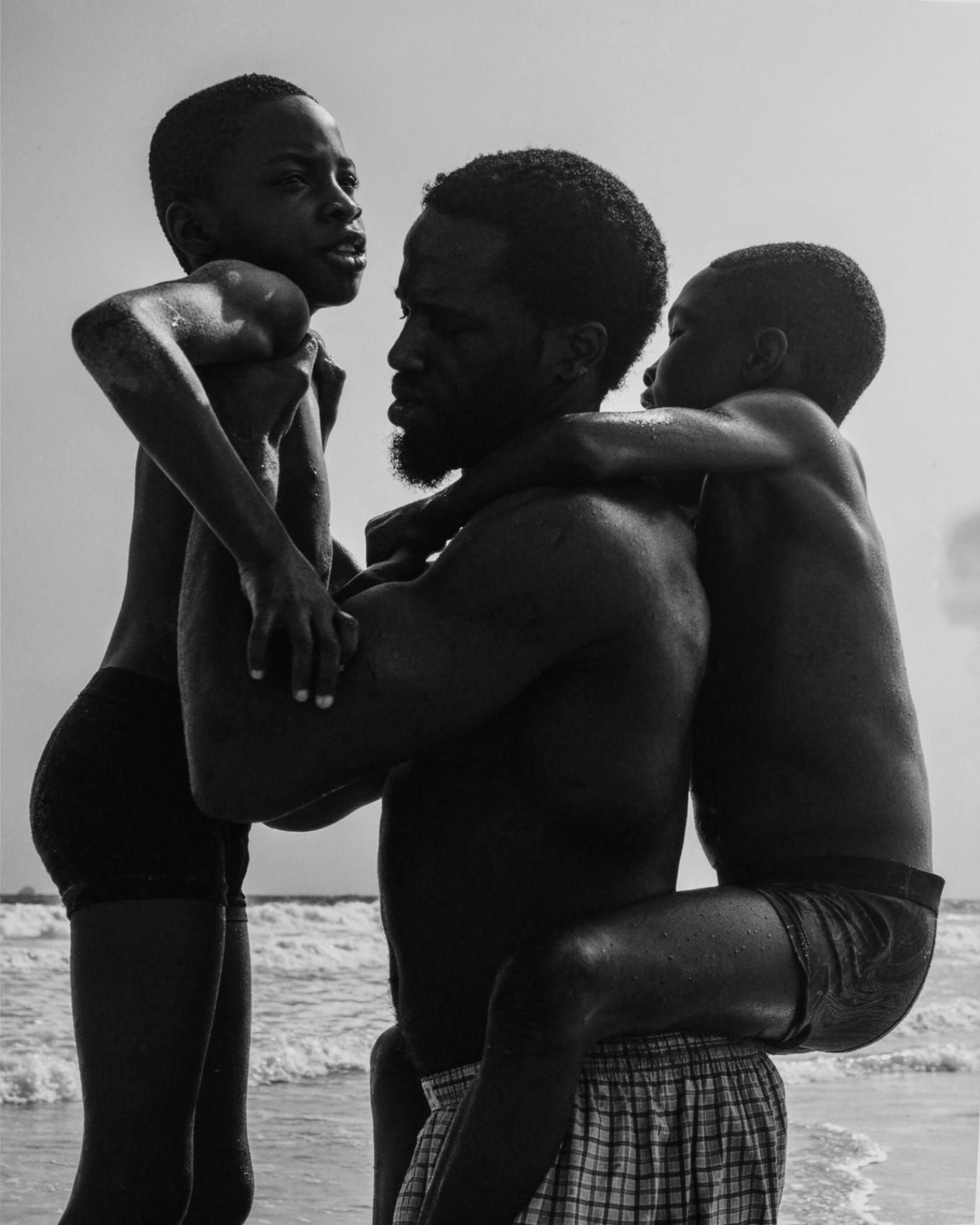
On My Father’s Shadow, Inherited Weather, and What Children Learn Before Language
Inherited Weather The emotional climate passed between generations, families, institutions, and societies before it becomes language.
Before My Father’s Shadow has fully declared itself, I noticed small things: the grain around a face, the fraction of silence before an answer, the way a child’s gaze lingers a beat too long on what adults are trying not to say. By then the pressure of the room had already changed. Some films tell a story. Some films return something that history refused to leave behind. This is one of those films.
The easy way to file this movie away is as autobiography. But autobiography usually tries to retrieve what happened. This film reaches for something harder. It gives form to what never had the chance to settle into memory at all. Akinola Davies Jr.’s debut feature, co written with his brother Wale Davies, turns that absence into a single day in Lagos during the 1993 election crisis. It premiered in Cannes’ Un Certain Regard and received a Caméra d’Or Special Distinction. Those facts matter, but only up to a point. The film earns its place by knowing exactly where feeling sits inside form.
It plays like a memory that might also be a dream, a fabrication, or a ghost story. That is why the tonal control feels so exact. This is not confession laid out for public use. It is cinema used to stand near what could not be kept. The result is a father-son drama that feels earthly, but never fully graspable.
Arké Imago is interested in that kind of seeing: the moment when an image stops being only an image and becomes a way of reading human behavior. Not behavior as category. Not behavior as diagnosis. Behavior as pressure, posture, silence, delay. A film like this does not only ask what happened. It asks what remains in people when what happened could not be properly held.
The single-day structure matters. It keeps everything under pressure. Nothing has time to settle into neat meaning. Every conversation carries what came before and what may be about to break. What moved me most is that the film understands interruption as inheritance. The boys only partly get a father. The country is only briefly allowed to imagine a democratic future. The 1993 crisis is not backdrop. It moves through the frame as rumor, caution, delay, and the changed temperature of ordinary life. Political theft does not stay in parliaments or headlines. It enters homes. It gets into routes, tones, timings, the half second hesitation before an answer. That is how power reaches childhood: not first as theory, but as altered weather.
Anyone who has lived inside an institution knows this weather too. A room can change before an announcement is made. A corridor can know what a meeting has not admitted. People feel power before power gives itself language. Something in the greeting shortens. Something in the body prepares. The film knows this because the boys know this. They are not yet historians of the event, but they are already witnesses of its atmosphere.
That is why the children matter. They do not fully understand the event, but they understand pressure. They understand that the grown world has become unreliable. Children often do. They can feel when adults are speaking around something before they know the words for it. This is a coming of age film in the most serious sense: not self discovery, but first contact with adult ambiguity. The boys are learning, almost in real time, that love does not cancel fear, that protection can arrive mixed with confusion, and that history reaches a child long before it is explained.
The film is just as exact about the father at its center. He is not offered as a lesson in innocence or guilt. He is stern, evasive, compromised, magnetic, protective, inconsistent, and fully alive. This refusal to flatten him is one of the film’s most generous acts. Too much contemporary culture wants people sorted fast. This motion picture wants something harder: understanding without absolution, closeness without naïveté. It is plainly in conversation with inherited masculinity and with all the words men do not say to one another. It never excuses damage, but it also refuses the vanity of standing above its characters. It stays with them inside contradiction. That is not vagueness. It is mercy with intelligence.
What makes the film hurt, though, is attachment. The boys stay near their father the way children stay near what they cannot yet measure. They watch him, test him, move toward him, pull back, then move toward him again. Love here is not announced. It travels in fragments. A look that lands and passes. A correction. A silence that lasts a little too long. The nearness of a body that is still not the same thing as safety.
Every serious family film is also, quietly, a film about rooms, even when much of it happens on the move: who relaxes in them, who performs, who belongs, who is only visiting his own life. The film understands home not as a stable place but as a changing pressure between people. Safety is a relation, and the room can remain standing after the relation has failed.
The dialogue knows better than to explain the film to us. People speak as people do when they are withholding, protecting, performing normality, or simply trying to get through the hour. Much of life is lived under an etiquette of surface, and the film knows that. Normality here is not fake. It is labor. It is how people carry the unbearable until it can be named. Beneath almost every exchange, another negotiation is underway: fear, pride, disappointment, care, shame, the wish to be seen, the wish not to be exposed. What the scene says is one thing. What it carries is another.
Formally, the film is doing more than the polite language around it has yet to catch up with. The camera behaves as if childhood gives it permission to dream. It notices ants, insects, hands, sideways glances, background tremors, small gestures of fear and care. It knows that children are closer to the ground and therefore closer to the smallest signs. Every line seems to have a hidden room behind it. Every scene carries another scene underneath the spoken one. Filmed on Kodak 16mm, the image has grain not as decoration but as touch. The world does not look embalmed in nostalgia. It looks handleable, bruisable, perishable. Again and again the film opens clearings of air inside the story: nature, distance, the animal world, the edges of the city, moments when reflection happens by not looking straight at the thing itself. Davies lets the film breathe so thought has somewhere to arrive.
This is where the film becomes a work of Visual Humanism. It studies people not by explaining them, but by staying close to the signs through which they become readable: a withheld answer, a father’s hand, a child’s angle of looking, a city’s heat, the silence after a sentence that should have comforted someone but did not. The film trusts that human beings are not only revealed by what they say. They are revealed by what they make others carry.
And then there is Lagos. Not scenery. Not “setting.” Not exotic evidence for a foreign gaze. Lagos in this film is witness, teacher, pressure system, and chorus. Seen from the boys’ low angle and wide curiosity, the city becomes a field of improvisation, heat, style, rumor, hustle, military menace, and sudden tenderness. Davies understands that a city is not made legible by skyline but by its working nerves. A shirt gone dark at the collar. A bus window clouded with dust. Money changing hands quickly. The look adults give one another when the street has turned political before noon. The camera lingers not to decorate but to honor the people who make the city readable: strangers, workers, traders, children, men and women carrying private burdens through public turbulence. Its Lagos feels inhabited before it feels observed.
The film also knows when the visible world is not enough. The beached whale. The circling vultures. The prophetic rhythm of certain encounters. The sense that people are not only present in the ordinary way, but accompanied by what they have lost and by what history refused them. These are not ornaments hung on realism for prestige. They are part of the film’s thinking. Children do not separate myth, politics, death, religion, and family as neatly as adults do. Neither, at crucial moments, does life. This is a film where presence is always shadowed by disappearance, and disappearance is never final. Even what is gone keeps asking to be spoken with.
It is precise about the present too. We live in a culture that keeps asking us to choose between condemnation and sentimentality, between politics without intimacy and intimacy without history. Davies refuses that split. He lets love remain complicated without making it cold. Some films ask to be admired. This one asks to be carried. By the end, I did not feel that I had watched a memory reconstructed. I felt that I had been let inside something fragile that survived by remaining unfinished. The feature film leaves you quieter, but more awake to what people carry without saying
Afterimage
At the time of writing, MUBI lists My Father’s Shadow as streaming in several territories, including the US, Canada, UK, Ireland, Turkey, Australia, Germany, Italy, and Spain. To stay with the film a little longer, pair it with Wole Soyinka’s The Open Sore of a Continent, Helon Habila’s Waiting for an Angel, Teju Cole’s Every Day Is for the Thief, and Ben Okri’s The Famished Road. None of these replace the film. They just leave more air inside the room it made