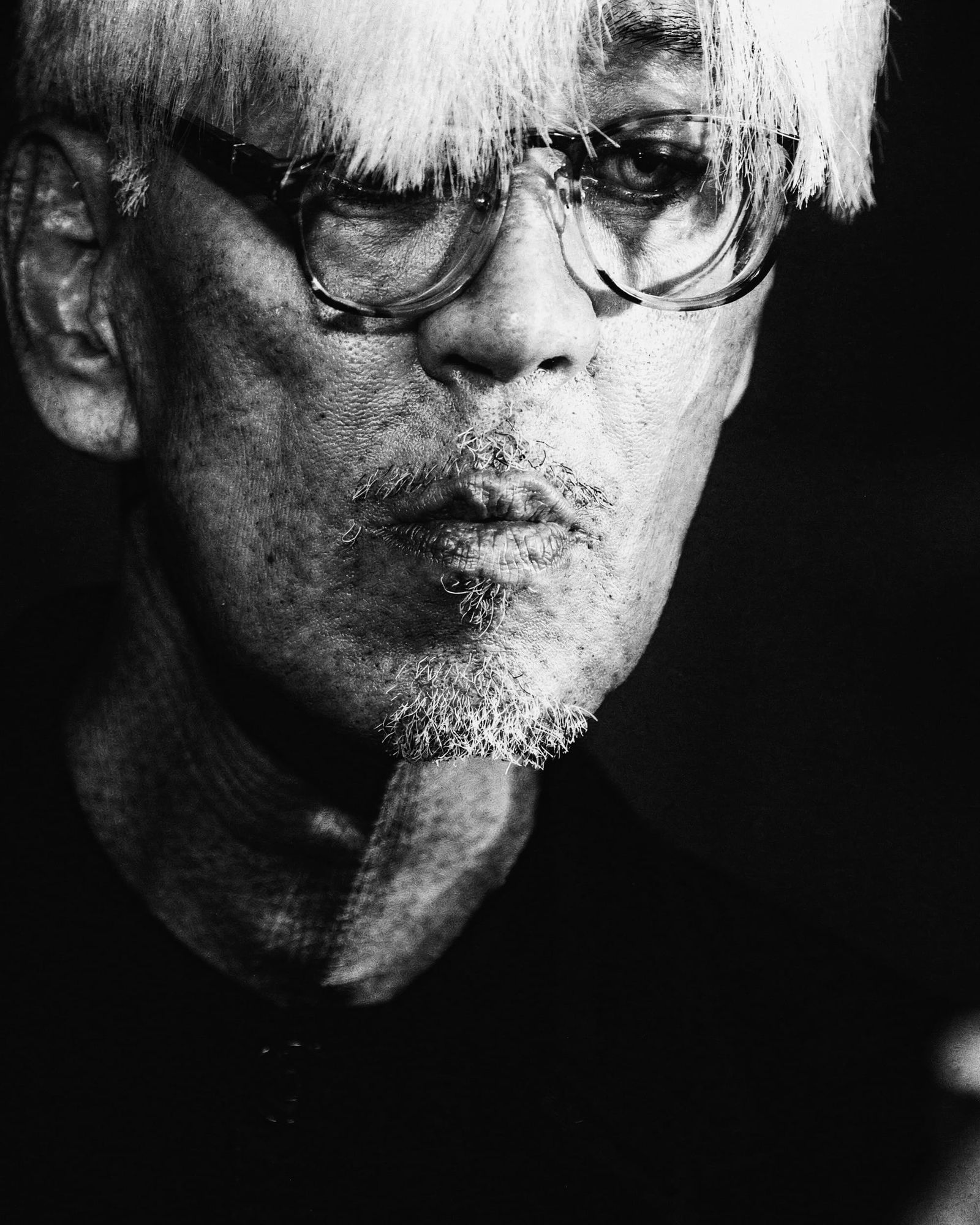
In Ryuichi Sakamoto "Opus" a final piano performance becomes an archive made of touch, breath, and a room asked to listen.
On 19 May, when Ryuichi Sakamoto , Opus, comes to Italian cinemas for one evening only, the date will give the film something streaming cannot quite provide: the pressure of a room. At 20:30, in that Italian hour when the day has not fully left and the city is still carrying itself home, people will come in from offices, traffic, family messages, and private exhaustion. They will silence phones. Someone will fold a ticket into a pocket. Someone will keep a cough behind the teeth. A room full of bodies will try not to make sound.
That is not incidental. In the documentary, silence is never empty. It is a thing held in common, and it changes because other people are near it. The smallest sound from the screen, a pedal, a breath, a hand leaving the keys, enters the social air of the cinema. It becomes everyone’s listening. A one night national screening is a practical fact, but also the right form. This is a film about finality, and finality should not be endlessly available. It should have an hour. It should ask us to arrive.
The easy description is that Neo Sora filmed his father, Ryuichi Sakamoto, playing twenty pieces alone at a piano in sessions shot roughly six months before Sakamoto’s death. That description is correct and almost useless. It tells us what happens, but not what the film does to time. It tells us that a man sits before an instrument. It does not tell us that the instrument begins to look like a second body, or that the body begins to look like an archive, or that the archive refuses the usual violence of explanation.
There are no interviews. No parade of witnesses. No soft retrospective voice stepping forward to tell us what the life meant. No childhood photograph arriving at the sanctioned moment. No expert smoothing contradiction into chronology. The film does not behave like a biography, even though it contains a life. It does not behave like a tribute, even though reverence is everywhere. It behaves more like an instruction in attention.
Sakamoto leaves us not a statement but a structure: twenty pieces, chosen and ordered by him, recorded over several days after live touring had become physically impossible. Officially, it is a 103-minute concert film, with pieces spanning Yellow Magic Orchestra, the Bertolucci film scores, and the late album 12. But the official category only takes us so far. The deeper subject is not repertoire. It is the way a person arranges what remains when explanation is no longer the most honest form.
This is where the film becomes more radical than its restraint first suggests. It asks what documentary can be when evidence is not biography but touch. Evidence is timing. Evidence is the slight delay before a note. Evidence is the space between camera and face. Evidence is the visible cost of continuing. The question is not only what happened to Ryuichi Sakamoto. It is how he placed his hands when the body was already negotiating with history.
A lesser film would have explained the illness until the music became illustration. A more sentimental film would have made the son-father relationship the visible wound. Opus does neither. Neo Sora’s tenderness is not an invasion of intimacy but a discipline of distance. He does not rescue his father from the frame. He does not expose him either. The camera comes close, but not to harvest tears. It comes close the way one listens closely: not to own what is fragile, but to stop missing what is there.
That may be the film’s clearest act of visual humanism. It studies a body without converting it into a case file. Sakamoto is frail, yes. He is tired, yes. There are moments when the act of playing seems to pull on him from inside the bones. But the film does not turn the body into a medical argument. It lets the body remain a working intelligence. His face is not presented as an emblem of decline. His hands are not presented as relics. They are still thinking. They are still making decisions. They are still capable of mischief, severity, memory, refusal.
At one point, the film allows us to hear the effort. Sakamoto asks for a break. Elsewhere, he wants to try again. Those words matter because there are so few of them. They do not interrupt the film’s silence. They give it a body. They remind us that the performance is not floating above physical cost. It is being carried through it.
The phrase “final performance” can close a work before the work has opened. It prepares us for farewell, and farewell is one of the easiest emotions to manufacture. Opus is moving because it resists that machinery. It does not beg us to mourn. It does not inflate the lastness of the occasion. It understands that death is already dramatic enough. What the film offers instead is concentration. Finality is not pushed into sentiment. It is built into duration, touch, and restraint.
Sakamoto spent a lifetime moving through sound as if no border around music could be trusted for long. His public life moved from the electronic intelligence of Yellow Magic Orchestra to classical composition, film scores, collaborations, environmental work, and a body of cinema music that made his name travel through other people’s images. The convenient story moves from the future-facing electronic artist to the late, contemplative pianist. But the screening makes that arc feel too tidy.
The film could seem like a return to the acoustic: wood, felt, hammers, old discipline, origin. But the more I watched, the more the opposite seemed true. Sakamoto’s final piano performance shows how electronic his silence always was.
By electronic, I do not mean synthesized. I mean attentive to signal, decay, texture, atmosphere, interference, distance, the life of sound after impact. The piano in Opus is not a nostalgic object. It is a machine for spacing and disappearance. A key is pressed. A hammer moves. Felt strikes a string. A damper lifts. The room receives the vibration. The note travels, thins, changes color, loses its edge, becomes almost air, then disappears into the next decision. This is not purity. This is technology made intimate. This is mechanics learning breath.
Neo Sora understood this physically. His direction keeps returning to the intertwining of performer and instrument: Sakamoto’s breathing, the creaks and soft thuds of the piano, the pedal, the bench, the small mechanical life around each note. That is why the film’s sound is not merely beautiful. It is bodily. The room tone is not background. The pedal is not noise. The instrument is not transparent. We are not listening only to compositions. We are listening to the conditions under which compositions survive.
Late Sakamoto was not interested in silence as absence. His own language was more precise. Speaking about why his music had become quieter and less dense, he described wanting fewer notes and more spaces, then corrected the idea of silence: space, for him, was resonant, still ringing. That distinction holds the film open. Opus is not silent in the ordinary sense. It is full of resonant space. It teaches us that a pause is not a gap. A pause is a place where sound continues changing without our permission.
This is why the black-and-white image matters. It does not make the film more elegant, though it is elegant. It removes the comfortable color by which cinema flatters memory. The monochrome gives us a world of pressure, edge, grain, light, and shadow. It makes the studio feel less like a location than a chamber where time is being tested. The lighting evokes the passage of one full day, the light turning and completing a circle before returning to its original position. This could have been a concept imposed from outside. Instead, it feels almost biological. Dawn, noon, dusk, night: not as scenery, but as metabolism.
A life does not pass in order, of course. Memory is not obedient. The twenty pieces are chronological only in the loosest emotional sense. They are closer to stations of pressure. “Tong Poo” arrives carrying the ghost of Yellow Magic Orchestra, but slowed down until the young electronic body inside it seems to be looking back at itself from another century. The film scores do not arrive as familiar quotations but as weather systems. The Last Emperor, The Sheltering Sky, Merry Christmas Mr. Lawrence: pieces that have lived inside other images now return to a bare room, stripped of costume, landscape, actor, nation, plot. What remains is not theme music. What remains is the nervous system of the melody.
There is something devastating about hearing music we associate with cinema after cinema has been removed from it. The pieces do not become smaller. They become more exposed. We hear how much image they once carried and how much image they can still generate without help. A single piano becomes desert, palace, prison, battlefield, childhood, tenderness, distance. The instrument is not accompanying memory. It is producing it.
That is one reason Opus is not only a concert film, even if concert film is its most accurate surface category. Neo Sora has described it less as a documentary than as a concert film: Sakamoto playing piano, with the music carrying the story wordlessly. I believe him. I also think the category trouble is the point. Opus may reject the habits of documentary, but it does not reject documentary truth. It relocates truth from statement to gesture.
A filmed hand can testify. Breath can testify. Fatigue can testify. So can the refusal to explain. Sakamoto is not interviewed because the performance is the interview. The repertoire is the answer. The order is the argument. The body is not background to the archive. The body is the archive.
That refusal has a hard courage now. The person behind the work is asked to keep speaking until the work can be consumed without mystery. Illness becomes content. Grief becomes access. Legacy becomes a package. Everything must be accompanied by a statement, preferably one that can be quoted in the headline. A public trained to consume endings can begin to forget the difference between witness and possession. Opus refuses that transaction. It does not say, “Here is what I meant.” It says, more quietly and more severely, “Listen to how I chose to leave it.”
This is not evasive. It is exact. It is also generous. Sakamoto gives the public something finished without pretending the life is finishable. He does not hand over a monument. He hands over an encounter. In a statement released with the film, Sakamoto explained that the project was conceived as a way to record a performance, while he was still able to perform, that would be worth preserving for the future. He also said the effort left him emptied and worsened his condition for about a month, yet he felt relieved to have recorded a performance he was satisfied with.
That fact changes the moral temperature of the film. The performance is not simply given. It is paid for. But the movie never asks us to admire the cost more than the music. Too much art about illness turns endurance into moral decoration. Here endurance is present, undeniable, but it is not the point. The point is form. The point is attention. The point is that even near the end, Sakamoto was not merely surviving his work. He was still editing it.
He was still choosing.
That is why the one-night cinema event feels more than promotional. A stream gives access. A cinema creates relation. A stream lets us pause, wander, check a message, make tea, return, half-listen, half-remember. A cinema asks the body to keep time with strangers. You cannot privately own the silence. You have to share it. You have to become aware of how loud your own breathing is. For a film so concerned with breath, that matters.
Outside the screening, the underlife of the city will keep moving: traffic lights, bar counters, scooters, late trains, people checking messages beneath the poster. Inside, the film asks for a rarer civic act: staying with something without immediately turning it into use. We live among tools that promise intimacy while training us out of presence. Opus does not argue against those tools. It simply gives us a room where they are not enough.
In the cinema, it makes the audience part of the room without letting us enter the room. We remain outside the studio, but inside the duration. That distance is painful and right. We are not collaborators. We are not family. We are not witnesses in the sentimental sense. We are listeners arriving late to something prepared for us by someone who knew he might not be there when we received it.
Attachment to an artist is never clean. Many of us met Sakamoto inside other people’s images: a battlefield, a palace, a desert, a childhood room, a late train home with one melody still moving in the headphones. A melody may become ours precisely because it never belonged to us. That is why it can feel intimate without pretending to know him. It does not give us possession. It asks attachment to become respect.
This is where I felt the film move from portrait to ethics. It asks how to look at another human being without taking too much. The answer is not to look less. The answer is to look better. To look with patience. To let the person remain complicated, working, unavailable in certain ways. To accept that not everything intimate should be translated into information.
Visual humanism, in this film, is not a slogan for tenderness. It is restraint with moral intelligence. It is the camera knowing when not to behave like a mourner. It is the editing allowing a pause to remain slightly uncomfortable. It is the sound mix refusing to clean the body out of the music. It is the decision to leave the piano’s mechanical life audible, because the human being at the keyboard is also mechanical, also spiritual, also tired, also precise.
There are moments when Sakamoto’s hands hover over the keys as if they are remembering the future. That sounds impossible, but the film lives in that impossibility. The hands know pieces the body must now negotiate differently. The old tempos cannot all return. The old force is altered. But alteration is not diminishment. The slower “Tong Poo” is not a weakened version of the earlier work. It is a late version. It knows more about vanishing. It has less muscle, perhaps, but more atmosphere. It has learned the intelligence of not rushing to become itself.
Anyone who has watched someone continue doing what they love after the body has begun setting terms will understand this. The work changes because the body changes. The gesture becomes smaller, but not less full. A person reaches for the cup differently. Takes the stairs differently. Answers after a longer silence. Plays a phrase as if each note must be asked whether it still wishes to belong to the world. This is not tragedy in the theatrical sense. It is the ordinary terror of being alive inside time.
Sakamoto makes that terror musical without making it melodramatic. The notes arrive as if aware of their own disappearance. The room receives them without consolation. Again and again, the film lets us hear decay not as loss but as continuation by other means. A note leaves the key and becomes resonance. Resonance becomes space. Space becomes listening. Listening becomes memory.
This is what self-archiving means here. Not preserving the self as image. Not fixing the life into a statement. Not gathering documents so the future can master the past. Sakamoto’s archive is temporal. It only exists when played, heard, shared, endured. It cannot be separated from the body that made it, but it also survives that body because the body chose its form carefully enough.
What this motion picture gives us, finally, is not the chance to say goodbye to Ryuichi Sakamoto. That would be too simple, and perhaps too flattering to us. We are not the ones granted the dignity of closure. The film gives us something harder: attention without ownership. It reminds us that a life cannot be summarized without being harmed. It suggests that the most truthful archive may not be the one with the most information, but the one that preserves the right silence around what it knows.
By the end, I did not feel I had watched a career being sealed. I felt I had watched a man keep faith with sound past the point where effort could be hidden from it. One piano. One room. One body. Twenty pieces. Not a confession. Not a monument. The last machine for human silence, still ringing after the hand has lifted