Art, Home and a Night of Sound at Metropoliz
Inside a former factory on Rome’s eastern edge, families live among hundreds of artworks. During a free quadraphonic concert, a courtyard became a temporary interior of sound and sharpened the question at the heart of the place: what can cultural attention protect, and what can it never replace?
An Address Is Not an Arrival
Waze told me I had arrived at Via Prenestina 913. The blue dot stopped. For a second, I trusted it more than myself: the screen was certain; my body was not.
An address had been reached. The place had not
Via Prenestina does not perform Rome for you. Traffic moves past workshops, low industrial buildings, improvised signs, walls painted over and written on again, and the long eastern routes of people going somewhere practical. This is Rome at work, or waiting for work: distances, repairs, unfinished structures and lives that rarely enter the postcard.
On the map, MAAM, the Museo dell’Altro e dell’Altrove di Metropoliz_città meticcia was one point at the edge of the city. In front of me stood a former factory that was also an inhabited museum, a housing occupation, a courtyard, a political claim and, that evening, a stage.
The usual verbs of navigation, turn, continue, arrive; had brought me only as far as the entrance. I needed another verb, less certain and more difficult: to enter without taking possession.
The first thing that failed me there was the familiar grammar of visiting
In most museums, the experience has already been translated before we arrive. There is an entrance, a ticket, a sequence of rooms and an agreed distance from each object. The building tells us where to stand. A label tells us what we are seeing. A name, a date, a medium and an art-historical movement form a small structure of authority around the work.
Even before we feel anything, we have been taught how to behave.
Here, the categories refused to stay put
People Live Where Other People Visit
The place grew inside a former Fiorucci sausage factory occupied in 2009 by the housing movement Blocchi Precari Metropolitani to house Italian and migrant families without secure homes. The museum took form in 2012 through work involving inhabitants, artists, activists, Giorgio de Finis and Fabrizio Boni. Hundreds of works have since entered by donation, sharing the industrial complex with the lives already unfolding there: cooking, sleeping, raising children, repairing things, disagreeing, organising and trying to remain.
People live where other people visit.
That is not a curatorial effect. It is the condition of the place.
A corridor may lead towards a mural and also towards someone’s room. A wall may carry an artwork, but it also belongs to the practical use of a home, to a memory, to a daily route. A courtyard may hold plants, animals, conversations and domestic routines before becoming the setting for a public performance.
What appears to a visitor as an exceptional cultural space is, for someone else, the ground of an ordinary day.
At first, I called this openness. Later, the word felt too easy. A home does not become public simply because visitors are admitted. Access does not erase privacy. Hospitality does not remove boundaries. The tension between museum and home is not a charming contradiction arranged for cultural interest.
It is real.
The visitor has the privilege of leaving.
The resident wakes there the following morning.
That difference does not cancel the hospitality. It gives the hospitality weight: beneath the public event, someone else’s ordinary day continues.
I did not know every artist’s name, and the place did not punish me for not knowing.
Names matter. They recognise labour and intention. They connect a work to a history and return it to the person who made it. Later knowledge can correct an assumption or open another way through what we have encountered.
But knowledge should deepen an encounter, not police it.
A label can open a door. It should not become the only door.
Experience came first.
I encountered painted creatures, collaged bodies, wire forms, damaged surfaces, fragments of language and objects whose status I could not immediately determine. People paused near them without performing the reverence expected in a conventional gallery. Someone talked. Someone waited. Someone followed a dog. Someone read. Someone looked elsewhere.
Nobody had to stand still and look serious.
The works did not ask me to prove that I understood them. They asked me to spend time near them.
What I felt first was resistance to the speed with which culture can turn another person’s life into meaning.
Visual humanism, as I began to understand it, is not a style. It begins where looking gives up its right to own. It lets a person remain larger than the category surrounding them, a home remain larger than the story told about it and beauty remain beauty without becoming an excuse.
It begins with a refusal
A person is not evidence
A home is not scenery
A difficult life is not material for someone else’s sensitivity.
To see another human being does not mean that we have acquired the right to explain them.
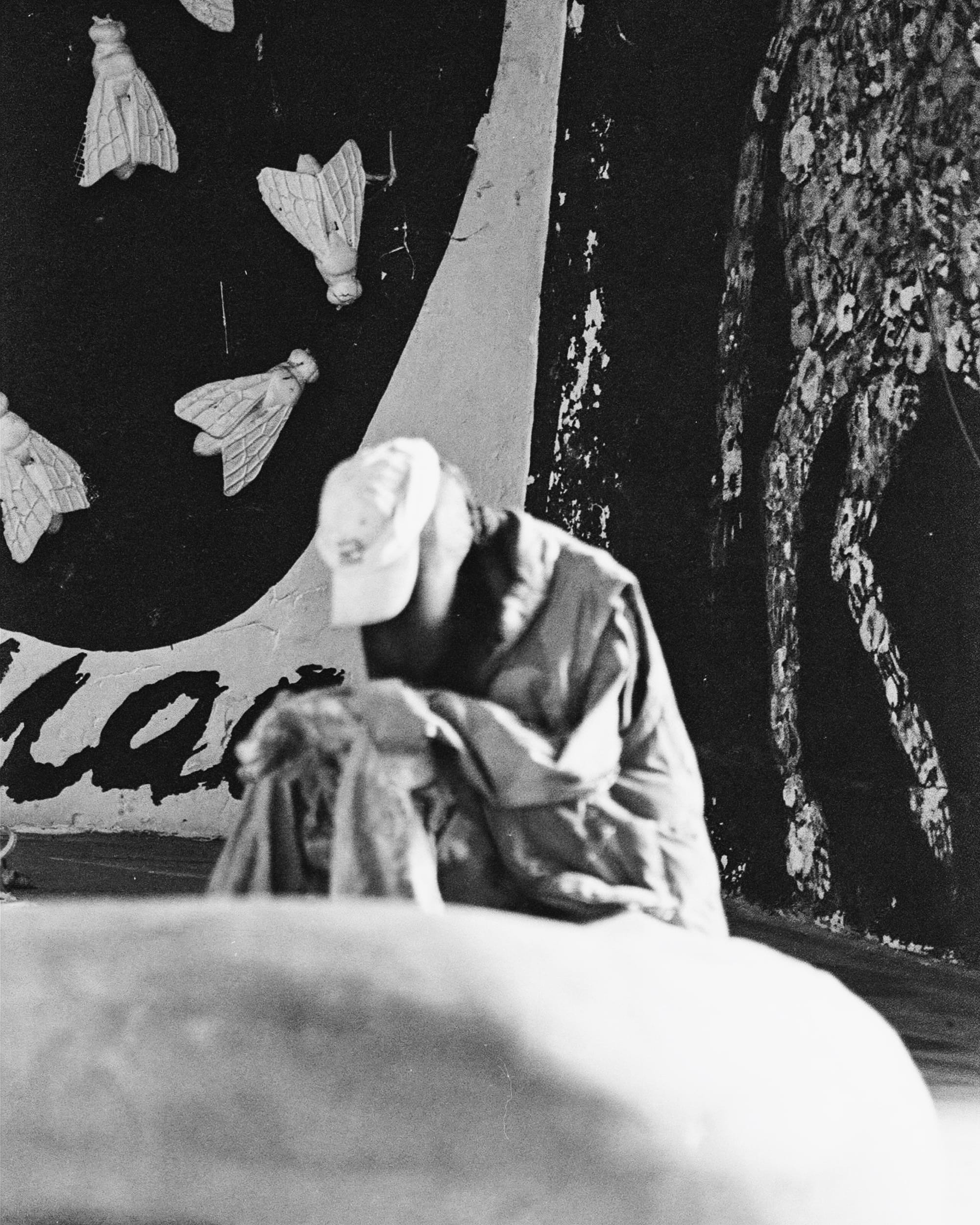
Near one wall, a person bent forward beneath pale painted moths. I did not know whether they were working, gathering something, resting or attending to a private task. Their face was not visible to me, and the uncertainty mattered. The person was present without becoming fully available.
There is a kind of looking that cannot tolerate this. It wants the face, the context, the explanation, the emotional key. It wants to know what a scene means and what role each person is playing.
The desire is not always cruel. It may begin in curiosity or sympathy. But sympathy can still become possession when it refuses to leave anything unknown.
Not every life needs to become legible to the visitor
No person is required to become a symbol of the place around them.
There are parts of every life that remain inward: memories not offered, contradictions that would not fit a public account, a private irritation, a joke, a fear, a thought having nothing to do with the politics around it.
Housing, migration, work and inequality matter. But none of these conditions should be allowed to consume the entire human being.
Every public identity has a private remainder.
Visual humanism begins by not filling it in
The Ordinary Work of Staying
The courtyard made this clearer
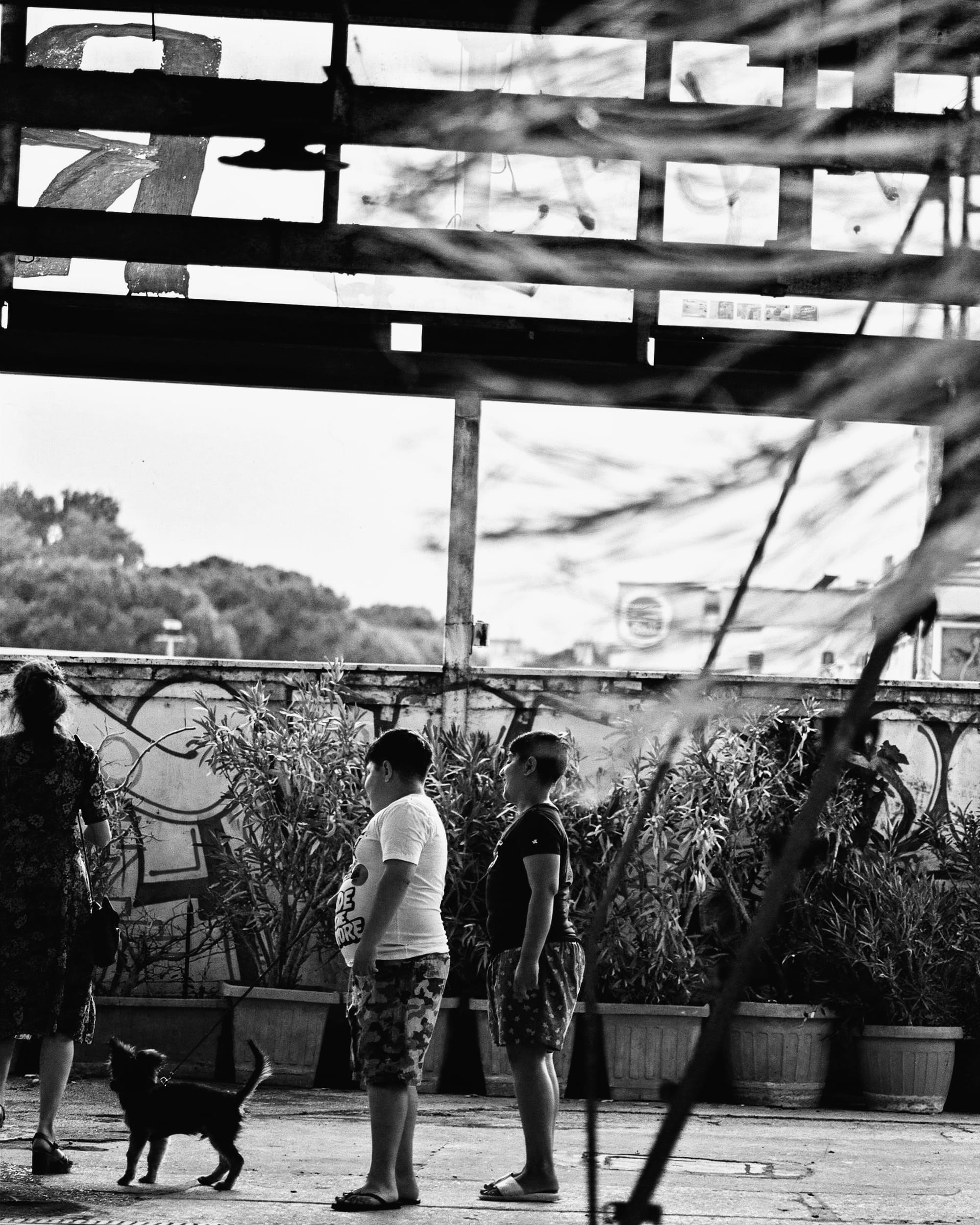
Several people stood near plants in terracotta containers while a small dog moved across the ground. Above them, the open industrial structure exposed the pale sky. Beyond the wall, low buildings, trees and a distant fast-food sign belonged to the city continuing outside.
Nothing dramatic was happening.
That was precisely what held my attention.
Most of what keeps a life going happens in hours no one archives. Waiting for someone. Watering a plant. Walking a dog. Returning to the same courtyard. Moving a chair. Standing beside another person without the conversation becoming historically important.
These actions are easy to overlook because they do not announce themselves as care.
The dog expected another meal, another walk, another familiar voice. The plants had been placed in their containers and kept alive. Someone had noticed when they needed water. Someone expected them to remain there tomorrow.
A plant is a small appointment with the future.
Home is often described through architecture: a roof, a room, a window, a door, an address. But a home also accumulates through repetition. The cup remains where it was left. A particular footstep becomes recognisable. Someone knows which light must be switched on first. A dog follows the person it trusts. The same patch of ground receives another day.
Home is not only a structure.
It is a pattern of return.
Near the plants, two people stood beside each other while the dog circled close to them. I could not tell what they were to one another, and I did not need to. One shifted slightly, making room for the other.
Something in me recognised the gesture before I could name it.
Perhaps attachment begins not in becoming one, but in losing certainty about how much space is mine.
We often speak about love and belonging as feelings. Attachment is also practical. It appears in waiting, carrying, remembering, moving aside and returning. It is the quiet revision of one life around the fact of another.
A home begins in much the same way: somebody makes room.
Still, tenderness cannot be asked to do the work of law.
A plant is not a housing policy.
A dog’s loyalty is not legal security.
Care is not a property right.
The ability to create a home under precarious conditions must never become an excuse for leaving those conditions unchanged. Resilience is a handsome word when spoken by people who do not have to depend on it.
Writing about the place carries a similar danger. Words such as authentic, radical and alive can turn insecurity into atmosphere. They can make neglect seem meaningful merely because people have answered it with imagination.
Their invention does not acquit the conditions that made invention necessary
What Art Can and Cannot Protect
Most museums protect objects from bodies.
Temperature and humidity are controlled. Touch is prohibited. Food, animals, moisture, noise and unauthorised movement are treated as threats. The institution preserves the artwork by limiting the unpredictable presence of human life.
Here, protection runs in both directions.
Art has entered an inhabited space and become part of its cultural and political defence. The works share weather, repairs, arguments, domestic necessity, public events and the long process surrounding the building’s future. Their presence has made the site harder to dismiss as empty, marginal or disposable.
By the time of my visit, Rome had set in motion a complex process intended to secure public housing for the residents and preserve the museum. That process matters. So does the difference between a plan and a key in a door.
The artwork is still protected, but it has also been drawn into the work of protection.
Not completely, and certainly not magically.
An artwork can help defend a home; it is not the home.
A mural can gather attention; it cannot guarantee a roof.
A museum can give cultural visibility to people and a place the city has long treated as marginal. It cannot, by itself, secure housing rights, safety or permanence.
Its power is different. It changes the conditions under which disappearance might occur. It makes erasure harder to carry out quietly. It fills the bureaucratic word occupation with lives, works, meals, children, arguments, plants, performances, repairs and memories. It refuses the fiction that a place can be described only by its legal status.
Art does not solve the struggle.
It makes indifference harder to pass off as neutrality.
That may be the deepest civic function of this inhabited museum. It does not allow the city to pretend that nothing is happening there. It gives public form to a life that already existed and forces official Rome to look again.
Rome knows how to preserve a stone and illuminate it beautifully. It is less sure what to do with a living room that interrupts the official story.
A city reveals itself through what it protects without hesitation and what it forces to justify its existence
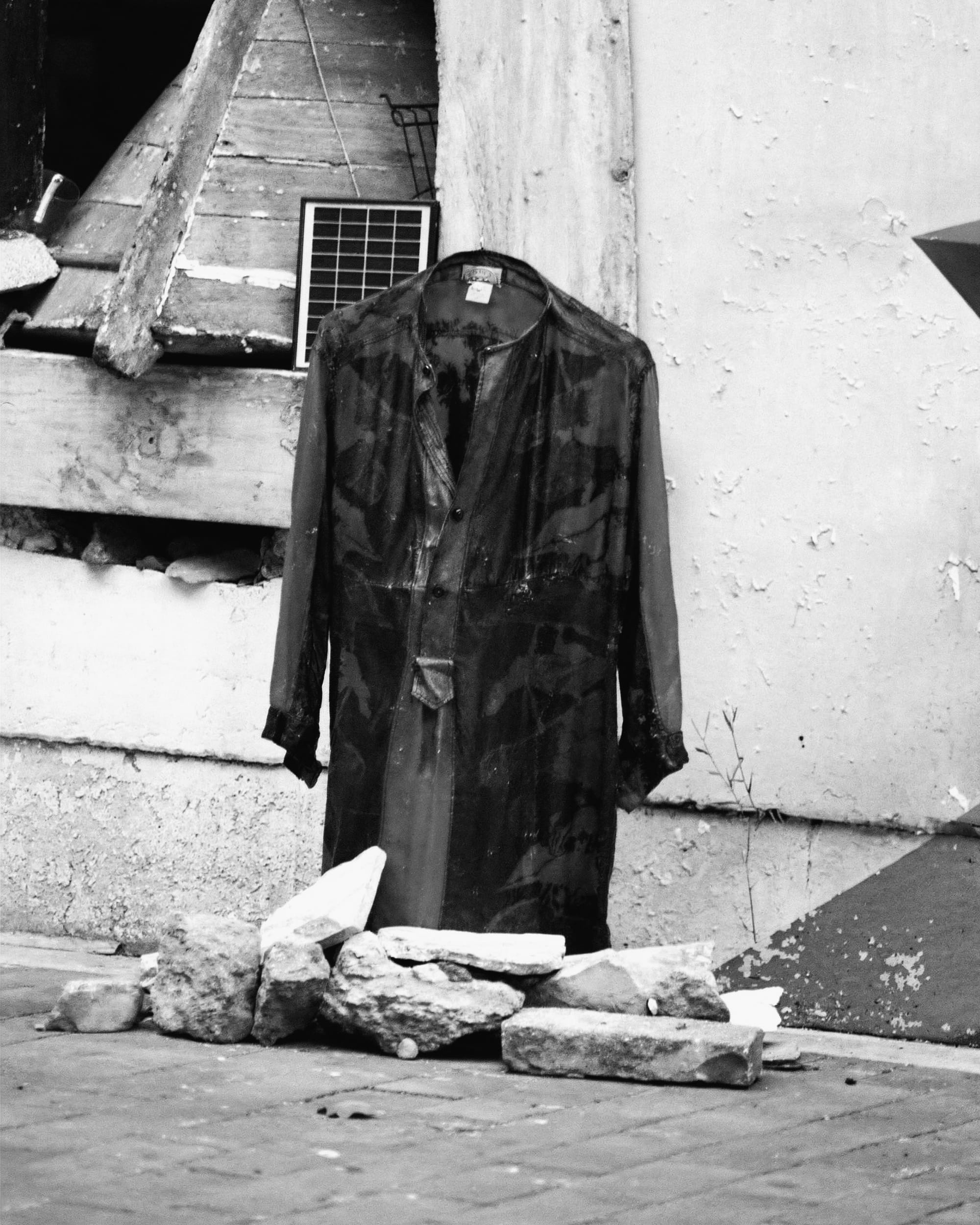
Against a pale, marked wall, a red-and-black coat hung above a line of stones and fragments. Its sleeves fell where arms should have been. The shoulders retained the outline of a body that had left.
I did not know whether it was an artwork, a costume, an ordinary garment temporarily placed there or an object moving between all three conditions.
The coat carried absence without explaining it.
Its interior was empty, but the emptiness had dimensions. The sleeves kept the length of missing arms; the collar held the space of a neck. A garment may be one of the most intimate forms of architecture: a portable room made for one body.
But the coat could not warm the person who was no longer inside it.
The damaged wall, the stones and the worn surfaces were visually powerful. Yet ruins are easiest to admire when we are free to leave them. For someone living with a damaged structure, the wall may not be poetic. It may be cold, unstable, expensive or exhausting.
The visitor can turn deterioration into atmosphere.
The resident has to inhabit it.
Visual humanism cannot call damage beautiful simply because damage gives art a dramatic setting. It cannot confuse the dignity of people living through a condition with the dignity of the condition itself.
Poverty is not beautiful.
Insecurity is not a texture.
If beauty belongs anywhere here, it belongs to the refusal to let a life disappear—not to the conditions threatening it.
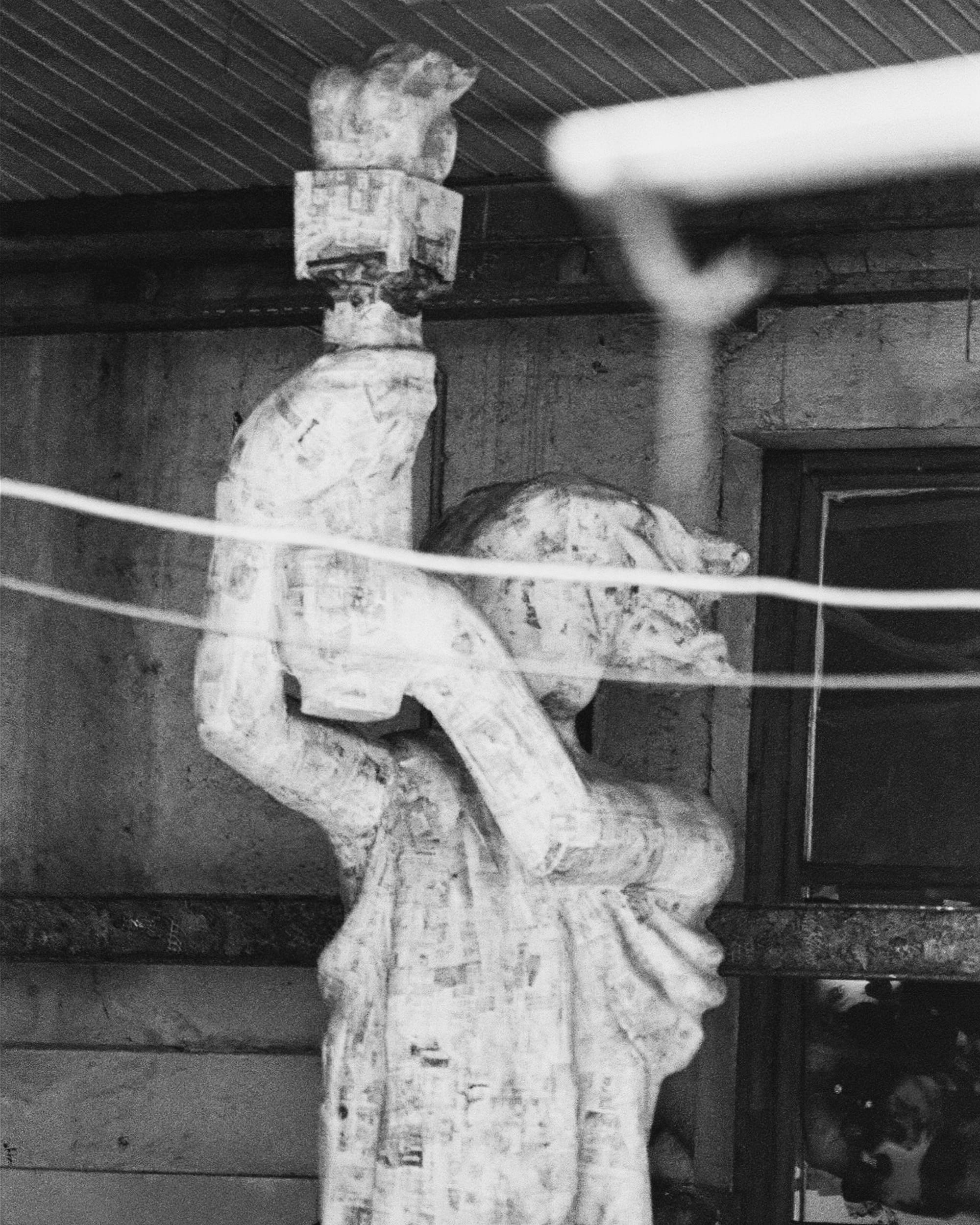
Nearby, a tall figure assembled from old advertisements, coloured paper and discarded messages carried another form. It might have been an animal, another body or a burden that could not be separated from care.
It carried
That gesture changed the way I understood the building around it.
Perhaps carrying is the first architecture.
Before a room becomes a home, someone has already moved aside, covered another body or taken some of its weight.
But care cannot substitute for public responsibility. The fact that a community can sustain relationships without adequate support does not make those relationships adequate support.
Home may begin in care.
It cannot be secured by care alone
Rome Seen from the Edge
That tension is already present in the name Metropoliz città meticcia: a mixed city made through coexistence among people whose histories, languages and positions are not the same.
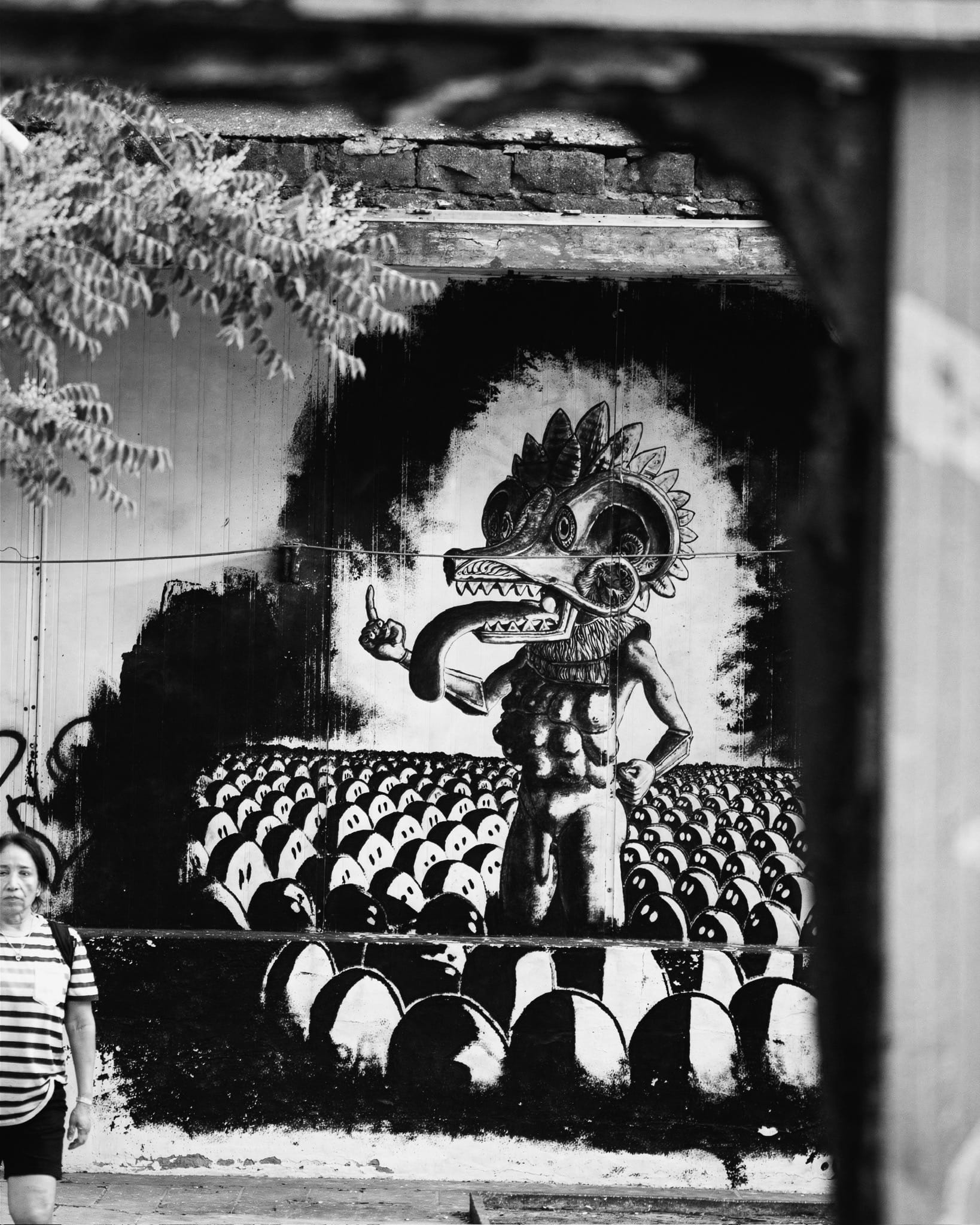
Mixture here is not cultural decoration. It is practical and difficult. It involves translation, misunderstanding, unequal burdens, competing needs and the ordinary friction of sharing space. Diversity becomes dishonest when it is used to make social pressure look colourful.
Cohabitation is not the absence of conflict.
It is the refusal to make conflict a reason for expulsion.
Metropoliz also has a lunar mythology. In Space Metropoliz, the collaborative project developed by Fabrizio Boni and Giorgio de Finis, inhabitants helped imagine a journey to the Moon, building a rocket from salvaged material because Earth had not made sufficient room for them.
The project was playful, but the wound inside the joke was serious.
When a city cannot provide a secure place for people already living within it, the Moon begins to look like a housing proposal.
The joke cuts because we can discuss colonies on another planet with solemn seriousness and still call secure housing in an existing neighbourhood unrealistic. The impossible receives patience, money and imagination.
The just is told to wait
Elsewhere, in this context, is not simple escape. It is a mirror held up to the present.
The Museum of the Other and the Elsewhere does not locate the other in some distant country. The other is already nearby, sharing the same city while remaining outside the city’s preferred representation of itself.
Elsewhere begins when the present loses its claim to inevitability.
The periphery is usually described from the centre, as though its meaning were defined by distance from what matters. But a city seen from its edges becomes another city. Monumental Rome gives way to roads, factories, bus routes, workshops, occupied buildings, improvised gardens and the accumulated labour of people keeping a life together.
Nothing here is staged to confirm Rome to itself. No dome, fountain or piazza waits to be admired. The official image of the city appears faintly, somewhere beyond the industrial structures and traffic of Via Prenestina.
Yet Rome is entirely present.
It is present as distribution: who receives protection, who receives attention, who is permitted to remain. It is present in the difference between a wall preserved as heritage and a room treated as provisional. It is present in the distance between cultural celebration and material security.
A city is not only what it displays in its centre.
It is also what it asks its peripheries to carry in silence.
This place does not stand outside Rome. It looks back at Rome and asks what kind of human life the city’s beauty is prepared to include.
That question might have remained silent had the concert not begun
A Nest Made of Sound
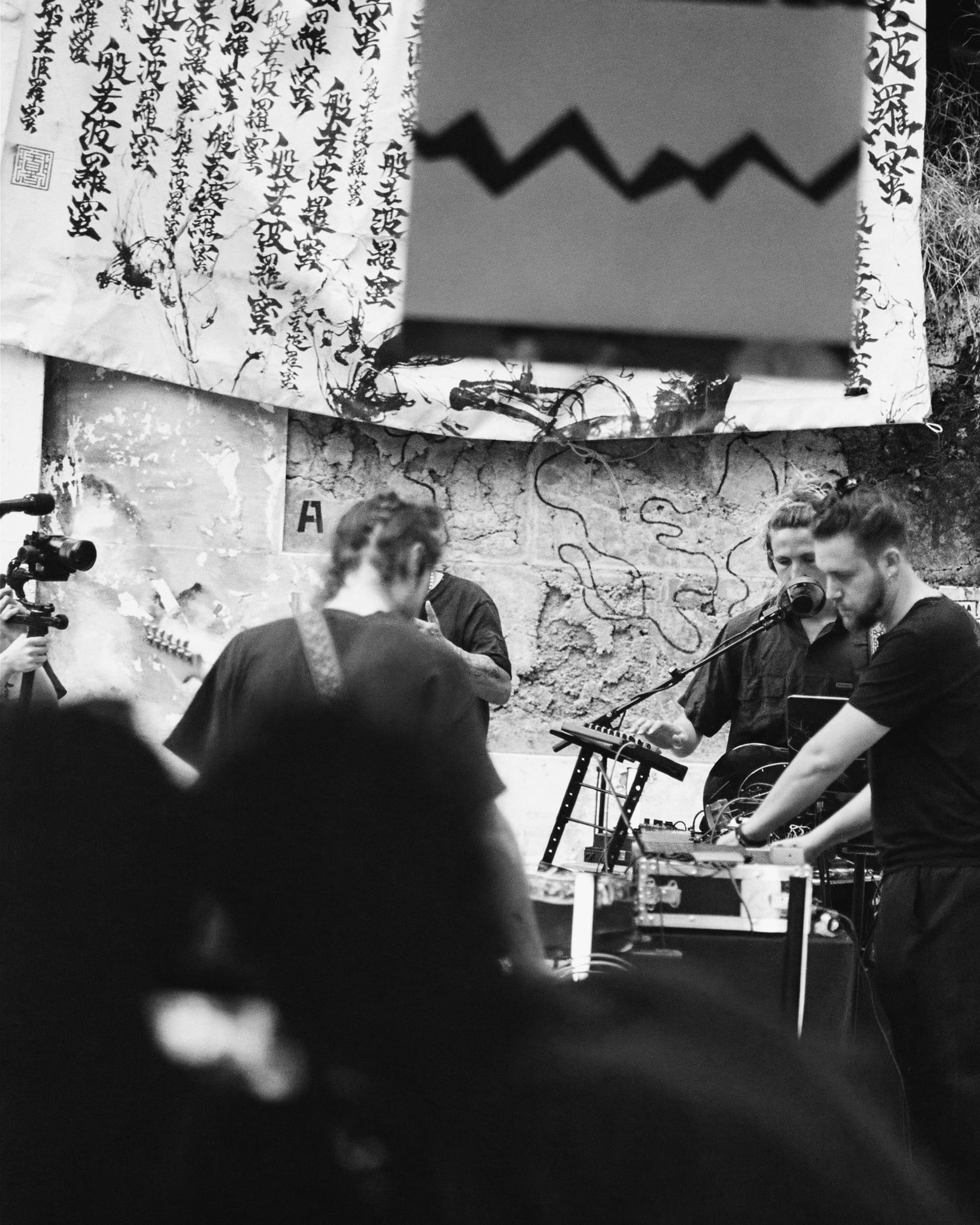
On Friday 29 May 2026, the Cortile della Luna hosted KLANG: NEST as part of IPER , Festival delle periferie 2026. The evening was billed with Ziúr, Cosimo Damiano and DIACRONIE Ensemble in a site specific quadraphonic programme concerned with dwelling, space and presence. Entry was free
The music entered a place where home was already material, intimate and contested.
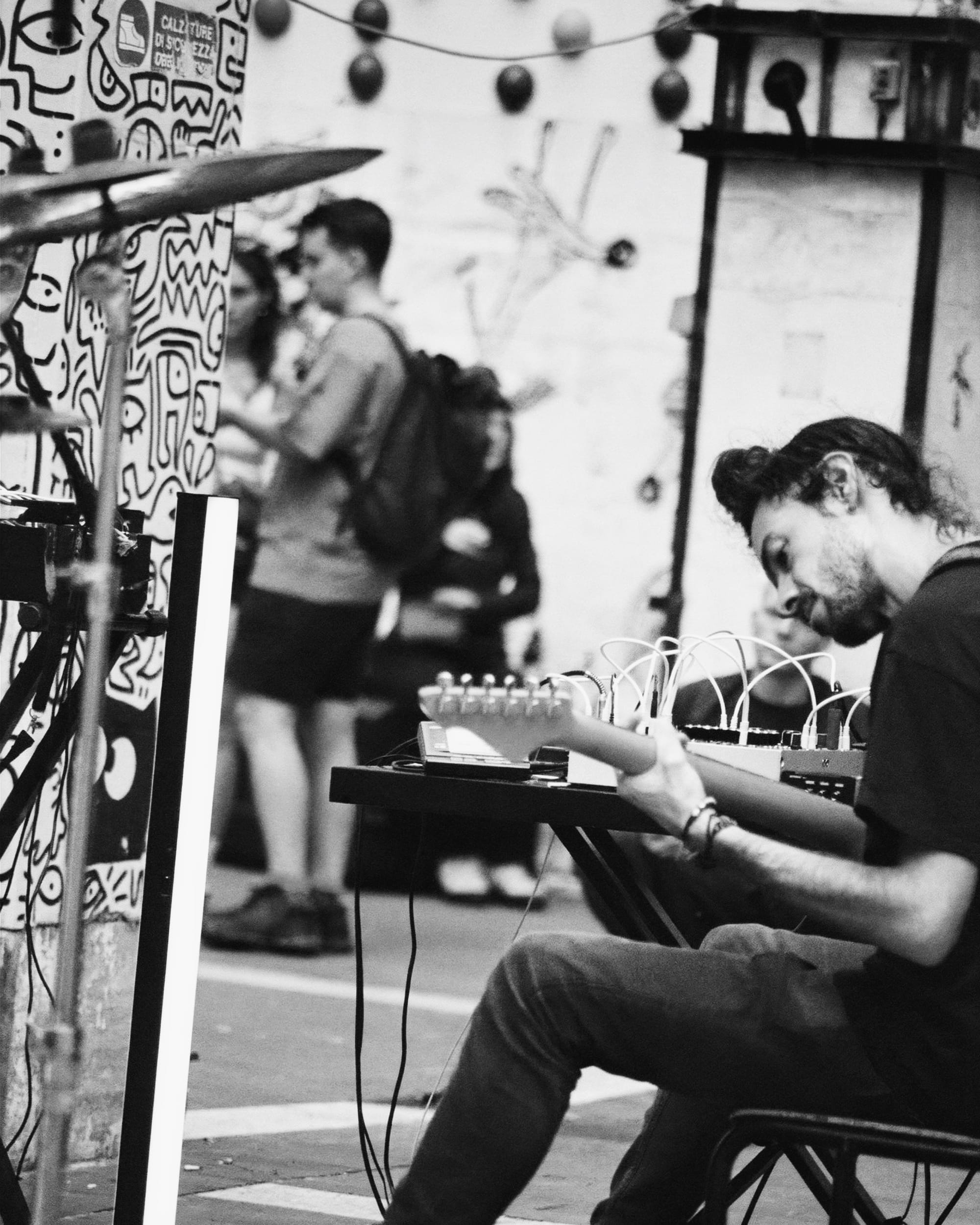
Before it began, the equipment had its own plain reality. Instrument cases stood on the ground. Cables crossed between tables and amplifiers. A plastic water bottle waited near a musician’s feet. Hands checked connections. Someone adjusted a microphone. Another person leaned over a machine to make a small correction.
These details kept the sound from becoming an abstraction.
Electronic music is sometimes imagined as disembodied: signal, software, circuitry, amplified atmosphere. But the performance depended on hands, wrists, breath, balance, concentration and fatigue.
A cable is not an idea.
It has to reach an outlet. It has to remain connected. Someone has to notice before a foot pulls it loose.
A sound system depends on bodies taking care of small things.
One musician leaned over a bass and a group of electronic devices. Another sat with a guitar beside a table of cables and modular instruments. A percussionist extended his body across the drums while someone behind him worked at a separate station. Each gesture entered a space already occupied by the gestures of others.
In a conventional concert, the stage establishes a front. Performer there, listener here. The quadraphonic system weakened that division. Sound crossed behind the body, appeared at the edge of attention and returned from somewhere unexpected.
The listener had entered its weather.
The idea of the nest was exact for this reason. A nest is neither a monument nor a permanent house. It is assembled from fragments. The labour of its construction remains visible. Each piece has been carried and placed in relation to the body it expects to hold.
A nest is temporary, but it is not careless.
The concert built such a structure from strings, percussion, electronic signals, amplified textures, feedback, pauses, breath and the acoustics of the courtyard. It created a temporary interior that no one could own or remove intact. When the performance ended, the structure disappeared as an object, but something of its arrangement remained in the body.
For a time, the people gathered there shared one changing interior.
They did not hear the same thing in the same way. One person may have found comfort where another heard tension. Someone may have followed the rhythm. Someone else may have watched the performers’ hands, noticed the walls, remembered another place or simply felt the pressure of sound in the chest.
The same sound reached everyone.
It did not make anyone the same.
Rhythm offered a model of this coexistence. The percussionist had to leave room for the electronics. The guitar had to respond to the silence around it. One performer’s decision changed what was possible for everyone else. Each person remained distinct, but no one was free from attention to the others.
Shared time survived through adjustment.
Not harmony, exactly. Adjustment.
A city also depends on people entering, withdrawing, repeating, interrupting and leaving room. Coexistence does not require a single rhythm to control everyone. It requires enough attention for different rhythms to remain possible.
The former factory itself is built from negotiated time. Domestic life, artistic work, political organisation, public visits and performances exist beside one another without any one of them fully owning the place. What must be repaired changes. New works arrive. Events begin and end. Residents continue with the obligations of the following morning.
Nothing here waits politely to become history.
Domestic life, art and politics keep revising one another.
The performance did not impose a clean musical object on the courtyard. It accepted the walls, interruptions, equipment and accumulated history as part of its architecture. Sound did not cover the place. It disclosed that the place was already resonant.
The evening was not made by musicians alone. It was also made by the people who prepared the courtyard, carried equipment, connected power, opened the space, listened, passed through or waited nearby.
The people at the edge were not background.
The music could remain strange, dense or unresolved without making the listener feel unqualified to respond. No specialist vocabulary was required before the sound reached the body.
Expertise could come later.
The same had been true throughout the building. I could feel before I could name. I could remain uncertain without being excluded.
But beauty, especially in a place marked by social struggle, can become an alibi.
I could leave saying that the place was moving, extraordinary and alive. All of those words might be true. They might also allow me to confuse my emotional response with a change in the conditions I had witnessed.
Feeling is not justice.
A concert cannot secure a legal right, and an essay cannot resolve the circumstances it describes.
The evening’s value was more modest and more exact.
It put the question of home inside the body.
Sound passed through a place where people live. It entered visitors who would later leave. For a time, it created an interior belonging to everyone and to no one: shelter without property, architecture without ownership, presence without permanence.
Then it ended.
The ending was part of its truth.
A sonic nest disappears when the collective labour sustaining it stops. A physical home cannot depend on that kind of fragility. Yet the temporary structure revealed something about a permanent one: a home is not only material enclosure. It is also an arrangement of attention, repetition, trust, memory and mutual adjustment.
Still, affection requires protection.
A relationship needs a room, and the room needs a door that cannot simply be taken away.
The music did not mirror the place.
It accepted its conditions
What the Place Asks Back
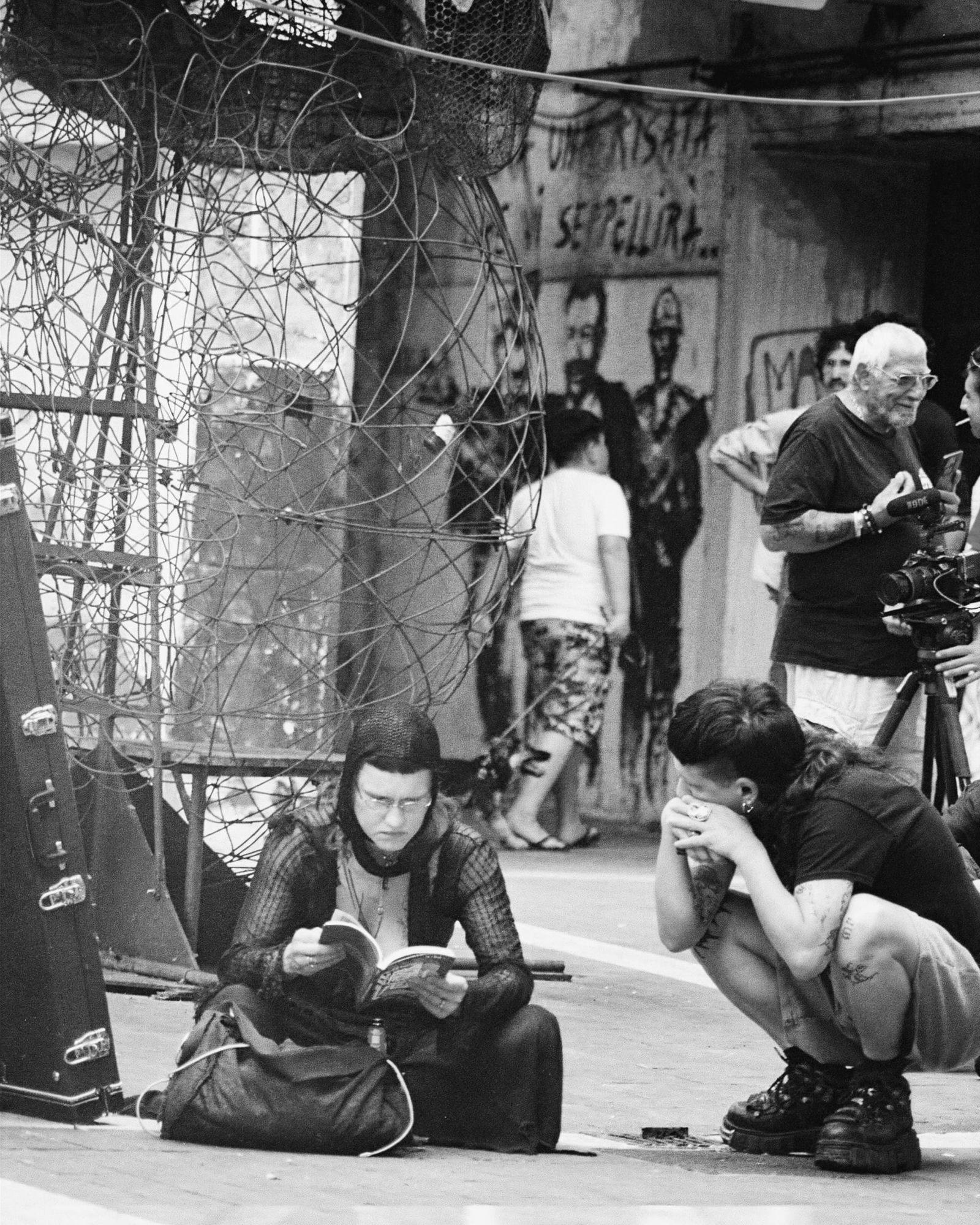
Later, beneath a large wire figure, someone sat reading on the ground. Nearby, another person crouched with their hands close to their face. A guitar case stood upright. Other people talked, waited and moved through the space.
No single person controlled the meaning of the scene.
The sculpture dominated the scale, but not the attention. The reader did not appear obliged to admire it. The crouching person was absorbed in something else. The guitar case waited for its next use. Several private worlds occupied the same public space without being pressed into one story.
Someone read.
Someone rested.
Someone talked.
Someone waited.
The artwork did not demand worship. It shared the space.
Perhaps genuine accessibility includes the freedom not to be overwhelmed by art: to sit beside it, read, talk or look elsewhere. The work had entered life instead of requiring life to stop before it.
The wire figure offered a model. It occupied space without sealing it. Air, bodies and architecture remained visible through its form. It was present without demanding that everything else disappear.
Recognition without enclosure
By the end of the visit, visual humanism no longer seemed to me like a theory of kindness. Kindness can still reduce a person. A difficult life can be regarded tenderly, made aesthetically moving and then left unchanged.
Visual humanism is a discipline against that conversion: against turning another life into evidence, atmosphere or proof of one’s own sensitivity.
Can we see without claiming?
The human being here was never an isolated figure standing at the centre of the world. The human appeared in the dog expecting another walk, the plant needing water, the coat holding the outline of absent shoulders, the cable someone had to keep from coming loose, the musician listening before entering and the body shifting slightly so another body could remain.
The human was not the figure alone.
It was the relation.
Another person is not me. I cannot possess their interior life. I cannot know everything that brought them into this place or what will happen after I leave.
And still, their life places a claim upon mine.
That claim does not require complete understanding.
It requires attention without conquest.
Not knowing every artist’s name had not invalidated the encounter. It had left me with work to do: to learn, to correct and not to treat a first impression as final knowledge.
That is why the museum seemed to breathe
Meaning moved in both directions. I entered the place, and the place altered the conditions of my attention. I listened to music, and the music made me conscious of the space my body occupied among other bodies. I stood near a work, and the work returned a question about how I was standing near the lives around it.
The museum did not simply receive attention
It breathed back.
On the way home, I missed a turn. Waze recalculated immediately. The blue line bent and continued as if nothing had happened.
The map corrected itself
I could not
I had arrived asking what kind of museum this was. I left asking what kind of visitor I had been
The place did not ask me to save it
It asked me not to look away and not to turn attention into an alibi